


A pre-roll filling machine is specialized equipment in commercial pre-roll production that loads ground plant material into pre-roll cones at a set weight and pack density. It settles and compacts the fill so each finished joint burns evenly.
The equipment handles the most labor-intensive parts of crafting cannabis pre-rolls: dosing material, filling cones without air pockets, and packing the column tight enough to hold its shape. One operator running a decent pre-roll cone filling machine can match what five or more hand-rollers produce in a shift.
The category exists because hand-rolling stops working at scale. A skilled roller turns out 200 to 400 cannabis pre-rolls in a shift with noticeable weight variation. A mid-tier automated cone filler produces that same volume in minutes.
Deploying a dedicated commercial pre-roll machine allows facilities to hit 1,000 or more completed joints per hour with just one operator.
A filling machine does not roll paper around flower; it fills cones that already have a paper tube and filter tip formed, which is why cone quality and grind consistency drive the finished result as much as the machine itself. Machines that stuff cones and machines that roll joints from flat paper are different tools with different price tags and different output profiles.
Key Takeaways
-
Cone fillers dose, vibrate, tamp, and finish pre-made cones, while true rolling machines wrap paper around flower.
-
Grind consistency and moisture level (roughly 10 to 14%) affect fill quality more than any single machine setting.
-
Machine choice should follow real daily output targets, cone sizes in your product line, and cleaning time between runs.
What the Equipment Does in a Pre-Roll Operation
A pre-roll filling machine replaces the hand-packing step in a pre-roll production line: it takes ground material from a hopper, distributes it into a tray of upright cones, and packs each one to a target weight. In high-volume cannabis production, everything upstream (grinding, moisture control) and downstream (weight checks, closing, packaging) still needs its own station.
Filling Pre-Made Cones vs. Rolling Papers Into Joints
Choosing the right commercial pre-roll machine requires understanding that two distinct equipment families get lumped together under "pre-roll machine." A cone filling machine works with pre rolled cones that already have a rolled paper tube and a crutch installed. Meanwhile, a joint rolling machine wraps flat paper around loose material and seals it.
Modern pre-roll cone filling machines dominate commercial production because they are mechanically simpler and cheaper. True rolling machines start around $50,000 and climb past $200,000, existing mainly for brands that demand hand-roll structure at volume.
|
|
Cone Filler |
True Rolling Machine |
|---|---|---|
|
Input |
Pre-made cones |
Flat rolling paper |
|
Typical throughput |
500 to 5,000+ CPH |
500 to 1,000+ CPH |
|
New capital range |
$200 to $150,000+ |
$50,000 to $200,000+ |
|
Output look |
Cone shape, consistent |
Hand-roll appearance |
|
Best fit |
Most commercial operations |
Premium brands |
The Core Jobs: Dose, Settle, Pack, and Finish
During automated pre-roll cone filling, every cone packer or cone packing machine performs four jobs in sequence. It doses material to a target weight per cone and settles that material down the paper tube so no air gap forms above the crutch. It then packs the column to an optimal draw density before closing the top by twist, tuck, or crown.
Reject control belongs in that list too. Machines with checkweighing catch underfills and overfills before they reach pre rolled tubes and packaging, which protects both compliance and customer trust.
How a Cone Filler Works From Grind to Finished Joint
The full pre-roll workflow runs grind, load cones, fill, settle, weigh, close, package. Material prep determines most of what happens next, and the filling machine sets the ceiling on line speed only when the steps around it can keep pace.
Why Grind Consistency Determines Fill Quality
Particle size decides whether material flows or jams. A commercial pre-roll grinder producing uniform particles lets the machine fill cones evenly at speed. Chunky pieces bridge across the cone opening and leave the joint underfilled. Overly fine dust packs too dense and chokes the draw.
Moisture sits right next to grind in importance. A target range of 10 to 14% keeps material workable. Below that, flower crumbles into powder. Above it, sticky material clogs hoppers and tears paper.
How Vibration, Gravity, and Tamping Settle Material
Vibration and gravity filling is the oldest approach and still the most common. A tray of upright cones sits under a hopper, vibration shakes material down into each tube, and a tamp rod or second vibration pass compacts the fill. This method runs 500 to 2,000 cones per hour depending on tray size.
Higher-end machines use graduated piston compression or centrifugal force. Piston systems press material into cones under controlled pressure, which tightens density consistency across strains. Centrifugal fillers spin material outward into the cones, and some operators find that centrifugal packing handles varied material better than vibration alone.
Closing Methods: Twists, Crimps, and Dutch Crowns
The top of a filled cone gets closed one of three ways. A simple twist is fastest and works fine for value SKUs. A crimp folds the paper down flat for a cleaner look in a tube.
The Dutch crown, produced by a Futurola Dutch Crown device or a dedicated Dutch crown closer, folds the paper tip into a tucked crown that seals the joint without excess paper. It photographs well and holds material in during shipping. Crown closers run as standalone benchtop units, so they slot in after nearly any filler.
Inspection and Pre-Roll Packaging After Filling
Every finished joint should hit a scale before it goes into packaging. A precision checkweigher with a tolerance around ±0.05g catches problems the eye misses. Visual inspection covers torn paper, crooked crutches, and loose crowns.
From there, joints move into pre rolled tubes custom printed for the brand, multi-packs, or child-resistant containers, then get labeled to state requirements. Packaging capacity is the step operators most often forget to size, and a slow tube-filling station will strand an expensive machine at idle.
Manual, Semi-Automatic, and Fully Automated Systems
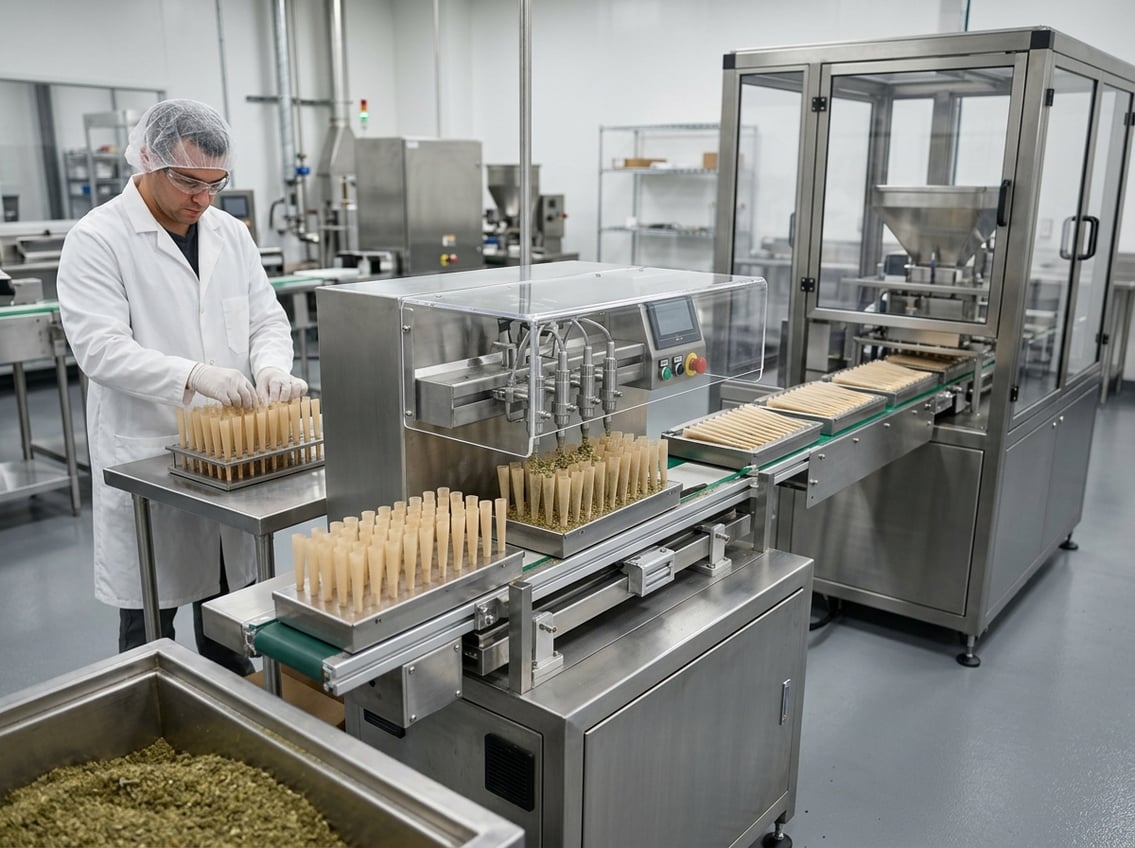
Pre-roll machines split into three tiers by how much human involvement each cycle requires. Manual trays need hands on every step. Semi-automatic fillers run the fill cycle while an operator loads and unloads. Fully automated systems chain filling, packing, and closing together.
When a Manual Tray Is Enough
A manual cone loader is a tray that holds cones upright while an operator scoops material in and taps or vibrates it down. These run $200 to $2,000 and produce 200 to 800 cones per hour with staff on them. Output quality depends entirely on the person operating it.
Manual trays make sense for testing a product idea, filling small custom orders, or running a dispensary's in-house SKU. They stop making sense the moment weekly volume becomes predictable.
What Semi-Automatic Batch Fillers Add
Semi-automatic machines handle the fill and compaction automatically while the operator loads trays and pulls finished cones. Capital runs $2,000 to $15,000 for 500 to 2,000 cones per hour.
The King Kone line is a staple in this bracket. Upgraded models like the King Kone V2 sit in this tier and fills 169 cones per cycle, making the King Kone V2 ideal for mid-sized production runs.
The Futurola Knockbox series is another industry benchmark. Units like the Futurola Knockbox 100 fill 100 cones per batch in minutes. One operator running a semi-automatic commercial pre-roll machine can match the output of five to ten hand-rollers.
When Full Automation Makes Sense
Fully automated cone fillers run 1,000 to 5,000+ cones per hour and cost $15,000 to $150,000 or more. The STM RocketBox line from STM Canna targets this range, with the Rocketbox Pro at $59,950 and an integrated harvest bundle at $69,995 combining grinding, filling, packing, and closing. The Mini RocketBox Plus+ handles 143 cones in 45 seconds.
Full automation pays off when daily demand sits above roughly 2,000 pre-rolls and stays there. Below that, the machine idles and the capital sits unused.
How to Choose the Right Machine for Your Output Goals
Selecting the right commercial pre-roll machine starts with a real daily number, not a marketing spec. When scaling production of cannabis pre-rolls, cone size compatibility, cleaning time, and reject rate influence total cost more than headline throughput does for most cannabis businesses.
Calculate Practical Throughput, Not Just Cones Per Cycle
Advertised cones per hour assumes continuous operation with no downtime. Real throughput subtracts tray loading, hopper refills, weight checks, and cleaning between strains. A machine rated at 2,000 CPH often delivers 1,200 to 1,400 in a working shift.
Multiply your target daily volume by a safety factor of 1.5 and size the machine to that. Then verify the grinder, checkweigher, and packaging station can each match it, because the slowest step sets line output regardless of the filler's rating.
Match Cone Size Compatibility to Your Product Line
Most machines ship with trays sized for a specific cone format. A tray built for 109mm king size cones will not hold 84mm half-gram cones without a swap kit. Check which sizes are supported before buying, and price the extra trays.
Operations running multiple SKUs should confirm changeover time between formats. If a shop sells bulk pre rolled cones in king, half-gram, and 0.25g formats, a machine with three quick-change trays beats one with a faster fill cycle and a 40-minute conversion.
Assess Labor, Cleaning, Maintenance, and Floor Space
Count the operators each machine needs per shift and the minutes it takes to break down and clean. Sticky resin builds up in hoppers and vibration decks, and a machine that takes an hour to clean between strains loses meaningful production time.
Floor space matters for automated lines that combine multiple stations. Measure the footprint plus clearance for the operator and cone tray staging.
Plan for Consistent Weights and Lower Reject Rates
Weight consistency drives compliance and margin at the same time. Every overfilled joint gives away product; every underfill risks a violation. Set a tolerance (±0.05g is a common target) and track reject counts by shift.
Loose packs and soft spots show up as customer complaints about canoeing. Adjusting compaction pressure and tightening grind spec fixes most of it before the machine gets blamed.
A Filling Machine Is Only as Effective as the Workflow Around It
The machine is one station in a chain, and the chain sets the output. A commercial pre-roll grinder feeding inconsistent particle size will undermine even a $60,000 filler, and a packaging bench that only tubes 400 joints an hour caps a 2,000 CPH line at 400.
Map every step before buying anything: material prep, moisture conditioning, grinding, cone loading, filling, weight verification, closing, packaging, labeling. Assign a throughput number to each. The lowest number is what the operation produces, and that is where the next dollar of investment belongs.
Operators who get this right treat cone supply as part of the plan too. Cone quality, tip alignment, and paper strength affect jam rates directly, and a cheap cone that tears in the tray costs more in rework than it saved at purchase. Testing a sample case of organic hemp pre rolled cones or whatever format the brand uses on the actual machine before committing to a pallet catches compatibility problems early.
Frequently Asked Questions
What is the difference between a pre-roll filling machine and a joint rolling machine?
A pre-roll filling machine loads ground material into pre-made cones that already have paper and a filter tip formed. A joint rolling machine wraps flat paper around material to build the joint from scratch. Cone fillers cost far less and dominate commercial production, while rolling machines start near $50,000 and target premium brands.
How many pre-rolls can a cone filling machine produce per hour?
Output ranges from about 200 cones per hour on a manual tray to 5,000 or more on a fully automated system. Semi-automatic vibration fillers land between 500 and 2,000 per hour. Real-world numbers run lower than the spec sheet once tray loading, weighing, and cleaning are counted.
What cone sizes work with pre-roll filling machines?
Machines use trays built for specific cone lengths, with 109mm king size and 84mm half-gram being the most common formats. Smaller 53mm and 0.25g cones need dedicated trays. Confirm which sizes a machine supports and how long a tray changeover takes before purchase.
Do I need a commercial pre-roll grinder with a cone filler?
Yes, for any operation running more than a few hundred cones a day. Uniform particle size prevents bridging at the cone opening and keeps fill weights consistent. Hand-grinding produces too much variation to feed a machine reliably at speed.
Are manual pre-roll machines suitable for a small cannabis business?
Manual trays work well for testing products, small custom orders, or in-house dispensary SKUs at $200 to $2,000. They produce 200 to 800 cones per hour with staff operating them, and quality depends on the operator. Once weekly volume becomes predictable, a semi-automatic filler pays for itself in labor savings.
How much does a pre-roll filling machine cost?
Manual trays run $200 to $2,000, while semi-automatic units like a King Kone or Futurola Knockbox range from $2,000 to $15,000. Fully automated commercial pre-roll machine setups cost $15,000 to $150,000 or more. Named examples include the Rocketbox Pro at $59,950 and a full harvest bundle at $69,995. Budget separately for a grinder, a checkweigher, and packaging equipment.